A BIM Execution Plan (BEP) is intended to establish how project teams will create, exchange, coordinate, and manage building information throughout a project. Yet even a technically detailed plan can fail when requirements are unclear, responsibilities are undefined, or contractual obligations do not match the proposed BIM workflow.
Architects, engineers, contractors, and BIM managers may find it difficult to enforce a BEP even after it has been approved during project mobilization. Enforcement becomes difficult when teams miss delivery deadlines, models contain coordination conflicts, or confusion exists about who must address a problem.
Preparing a BEP or getting the project team to approve it does not, by itself, make the document legally enforceable. The contract needs to establish how the plan applies to the parties and which requirements they have agreed to follow. Without these details, a disagreement may arise when one party claims a particular instruction was never part of its obligations. The contract terms and the law governing the project will determine whether that requirement is enforceable.
Before submitting the BEP, the team should compare it with the project documents to ensure nothing important is missing. This includes checking how the team will share project information, who will handle each task, and what steps the team should take if delays or other delivery problems occur.
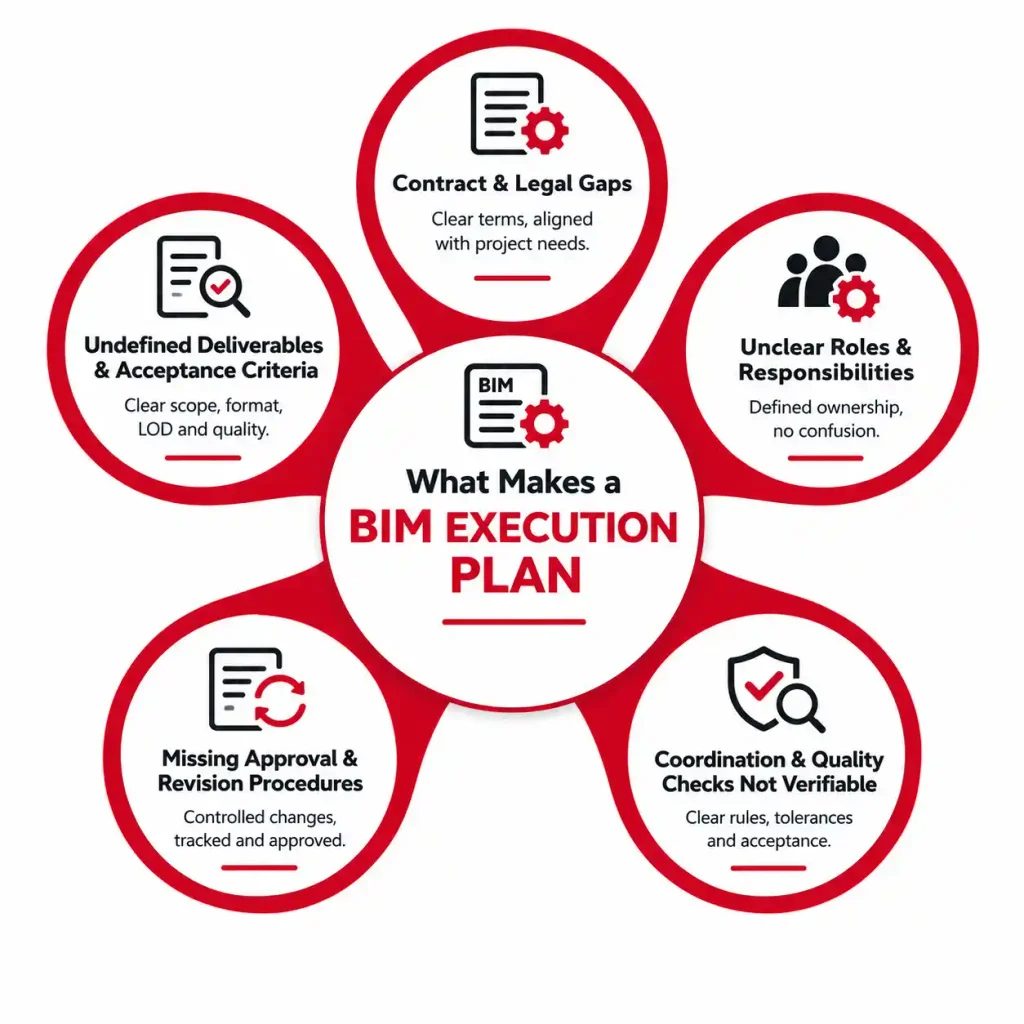
Key pillars of an effective BIM Execution Plan.
What Makes a BIM Execution Plan Non-Enforceable?
A BEP becomes difficult to enforce when its requirements cannot be clearly interpreted, assigned, verified, or linked to the project’s contractual obligations. The following weaknesses deserve particular attention.
The BEP Is Not Incorporated Into The Contract
Issues can arise when the BIM Execution Plan (BEP) remains a supporting document rather than being formally included in the project contract. Client approval alone does not necessarily make all the requirements listed in the plan legally enforceable.
The BEP may conflict with other project documents, including the main contract, scope of services, and the employer’s information requirements.
How to fix it:
Check the contract to determine how the BEP is recognized and which provisions are binding. If two documents conflict, the agreement should specify which takes priority. Before submitting the BEP, the commercial or legal team should review these terms to confirm they are consistent.
Roles & Responsibilities Are Vague
Saying that the BIM team will coordinate the model is not enough to define individual responsibilities. The BEP needs to state who is handling each task, the deadline for completing it, and who can approve the final work.
An MEP subcontractor might wait for the lead designer to deal with a clash, but the lead designer may expect the subcontractor to correct the model. If neither party takes ownership of the clash, it may remain unresolved and cause construction problems.
How to fix it:
The BEP should identify who is responsible for each task, including creating models, sharing information, coordinating work, reviewing submissions, approving deliverables, and resolving issues. A responsibility matrix can record these assignments and show who performs each task, checks the work, approves it, and receives the final deliverable. It should also clearly distinguish between the person who creates a model, the party responsible for its design, and the person authorized to approve it.
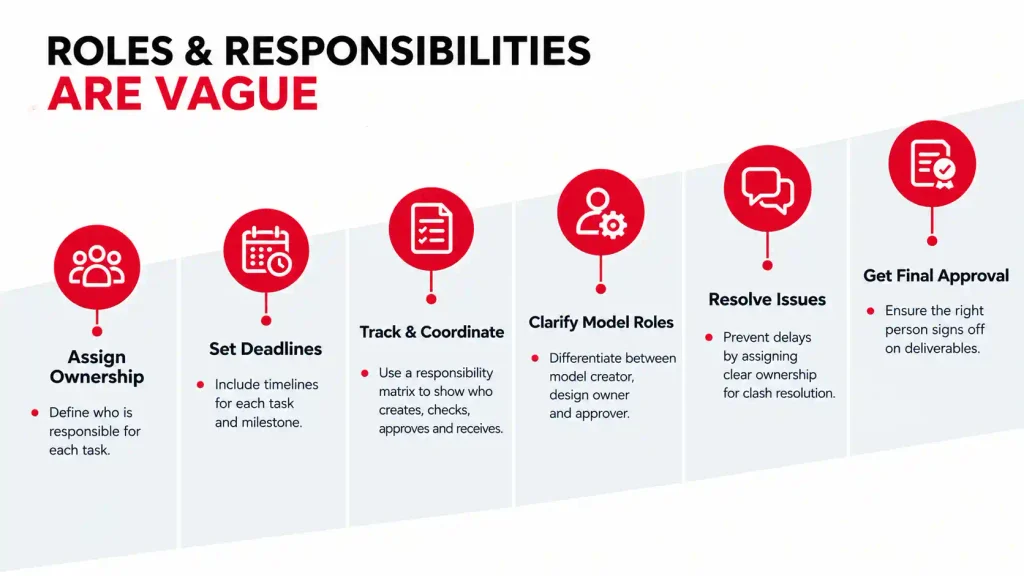
Workflow for clarifying roles and project deliverables.
Deliverables & Acceptance Criteria Are Undefined
A BEP needs to state exactly what the project team must deliver. Simply asking for coordinated models can lead to different interpretations. For instance, one team may submit a federated model and consider the work complete. At the same time, another may also require coordinated drawings, an issue register, and records of how clashes were resolved.
Mentioning the Level of Development (LOD) alone does not provide enough detail either. The BEP must explain what information each model needs to contain, the expected geometric detail, and the purpose for which the model will be used.
How to fix it:
For each deliverable, state its required format, scope, information content, submission date, and acceptance criteria, along with the party responsible for providing it. The BEP must define the information each model should include and the amount of geometric detail required at every stage of the project. Depending on the project requirements, the submission may need to include native model files, IFC exports, coordination views, and issue reports.
Information Exchange Requirements Are Incomplete
A BIM workflow may run into problems when project teams cannot use each other’s files properly. This can happen when they use different software versions, coordinate settings, or classification systems, or follow inconsistent file-naming rules. As a result, a model may be submitted on time but still be unusable by the team receiving it.
How to fix it:
The BEP should specify which file formats the team will exchange and the coordinate systems, naming rules, and classification standards everyone must follow. It should also state which software versions are compatible and when information must be delivered. The plan needs to explain how models will be uploaded, updated, checked, and shared through the CDE.
The BEP should follow the project’s agreed information requirements and set out how information will be managed, instead of treating these requirements as separate technical rules.
The National Institute of Building Sciences (NIBS) publishes the National BIM Standard–United States (NBIMS-US) Version 4, which includes dedicated modules for Project BIM Requirements, BIM Execution Planning, BIM Use Definitions, and COBie Version 3. Its BEP resources include templates that project teams can adapt to define project-specific information requirements and delivery processes.— SOURCE
Approval & Revision Procedures Are Missing
A BEP is often developed early, when some subcontractors, software choices, or delivery requirements are not yet finalized. If the document does not explain how changes will be reviewed and approved, different parties may keep working from different versions.
An undocumented change to the model exchange date or to the person responsible for coordination can lead to disagreements over the requirements the team originally accepted.
How to fix it:
Keep a record of each BEP revision, noting its version, approval status, and authorized approver—and state who can propose changes and who must review and approve them. The plan should also clarify when an approved change becomes effective for the project team. Store the current approved BEP and related records in the agreed Common Data Environment (CDE) so team members can check the same version.
Coordination & Quality Checks Cannot Be Verified
Requirements such as “all models must be clash-free” are difficult to enforce without defining what constitutes a clash, which elements to check, and how the results will be accepted.
A clash found during coordination does not always mean something is wrong with the design. Some intersections are intentional, and others may fall outside the agreed project scope. The team needs clear criteria for checking clashes and deciding which ones require action; otherwise, it becomes difficult to confirm whether the required checks have been carried out properly.
How to fix it:
Define coordination tolerances, clash test rules, review frequency, issue priorities, and closure criteria. Specify how issues are assigned and recorded, who verifies resolutions, and what evidence must accompany milestone submissions. Integrate clash detection services and BIM coordination services into the agreed workflow, with clear responsibilities for each participating discipline.

Reviewing site progress against digital blueprints.
How to Make a BIM Execution Plan Enforceable Before Submission
Once you have identified the weaknesses, the next step is to check whether the document can be implemented and assessed consistently across the project team.
Step 1: Align the BEP With the Contractual Documents
Check the BEP against the contract, scope of work, owner’s project requirements, applicable BIM requirements, and relevant project specifications. Identify conflicting dates, deliverables, responsibilities, and approval conditions.
Do not assume that the newest document automatically overrides an earlier one. The governing agreement should establish the applicable precedence and amendment process.
Step 2: Build a Responsibility & Deliverables Matrix
Create a single reference that connects each deliverable to its author, reviewer, approver, format, due date, and acceptance criteria.
For example, an MEP coordination model should identify the responsible model author, the required coordination checks, the party responsible for resolving issues, and the authority that accepts the submission. This is more useful than assigning general responsibility to the entire BIM team.
Step 3: Make Information Requirements Measurable
Replace broad statements with requirements you can check against evidence.
| Weak Requirement | Stronger Requirement |
| Models must be coordinated. | Discipline models must undergo the agreed clash tests before each specified coordination milestone. |
| Models must be submitted regularly. | Define the submission date, file format, revision status, and require model content for each milestone. |
| All issues must be resolved. | Assign issue priorities, responsible parties, target resolution dates, and closure verification criteria. |
| Models must meet the required LOD. | Specify the required geometry, non-graphical information, and intended use for each element or milestone. |
The goal is not to make every sentence more complicated. It is to remove uncertainty about what must be delivered and how you will assess compliance.
Ensure your BIM deliverables meet strict agency standards, USACE PxP mandates, and federal contract requirements.
Step 4: Validate the Technical Workflow
Before submission, verify that the proposed workflow is achievable with the team’s software, skills, and resources. Confirm model exchange formats, coordinate alignment, naming rules, file permissions, CDE workflows, and the availability of the required software versions.
For complex projects, Revit BIM modeling can help teams define discipline-specific deliverables and coordination interfaces. The BEP should explain how these outputs fit into the overall information delivery process.
Step 5: Establish Approval, Change Control, & Evidence
Specify the required approvals and how they will be recorded. Define what happens when a deliverable is rejected, a deadline is missed, or a team proposes a change to an agreed workflow.
Maintain traceable records of submissions, reviews, comments, revisions, and acceptance decisions. Where the contract permits corrective action, escalation, or other remedies, make sure the relevant process is clearly documented and consistent with the governing agreement.
Step 6: Conduct a Pre-Submission Compliance Review
Treat the final review as a quality gate rather than a proofreading exercise. Check contractual alignment, responsibilities, information requirements, deliverables, software compatibility, coordination procedures, and approval records. Obtain the necessary technical, commercial, and legal reviews before issuing the document.
The U.S. Army Corps of Engineers (USACE) provides an Advanced Modeling Project Execution Plan (PxP) template, example contract language, and a Minimum Modeling Matrix to support BIM requirements on its projects. Its May 2026 engineering manual specifies that the PxP must be included in the Design Analysis. This highlights the importance of following the applicable agency requirements rather than relying on a generic BEP template.— SOURCE
Common BEP Submission Mistakes to Avoid
Even a comprehensive BEP can be weakened by a few avoidable oversights.
- Copying a template without adapting it:
Generic clauses may not reflect the project’s scope, procurement route, or contractual arrangements.
- Using outdated standards references:
Check the applicable edition of NBIMS-US, relevant ISO 19650 provisions, owner requirements, and agency-specific guidance rather than relying on old templates.
- Leaving placeholders unresolved:
Confirm dates, software versions, responsible parties, and deliverable requirements before approval.
- Confusing model coordination with design approval:
Successful clash checks do not automatically establish design compliance or transfer professional responsibility.
- Treating approval as the end of the process:
Keep the BEP updated as project requirements change, and record each revision properly.
Before finalizing the plan, check whether an independent reviewer can understand who is responsible for each obligation, what action is required, the deadline, and what evidence will confirm that the requirement has been met, without needing further verbal clarification.
The Role of BIM Expertise in Strengthening the BEP
A strong BEP depends on input from people who understand how BIM works in practice. They need to know how project information will be managed, how different disciplines will coordinate their work, who is responsible for each task, and what is required to deliver the project successfully.
BIM specialists bring practical experience that helps teams decide what information to share, how to coordinate models, and what to check before delivery. They can also spot missing deliverables and set clear criteria for reviewing model quality. With support from BIM quality assurance and coordination services, teams can check that the agreed requirements are covered and that the planned methods will work for the project.
When a project team lacks enough in-house BIM staff, BIM outsourcing services can help manage the additional modeling and coordination work. However, the project team must still decide who is accountable for the outsourced work, how the submitted models and documents will be reviewed, and who has the authority to approve them. Outsourcing these tasks does not transfer overall project responsibility to the external team.
The BEP should set out procedures that the project team can follow with the staff, tools, and resources available to them. Including processes that look good on paper but cannot be maintained throughout the project adds little value.
Conclusion
A BEP is easier to enforce when the contract clearly states the requirements, each team member knows their responsibilities, and the expected deliverables are specific. The project team should review these details before submitting the plan. This gives them time to sort out differences between requirements and decide on working methods that everyone can follow.
Problems with a BEP often start when the contract does not clearly define its status, team members are unsure of their duties, or the required deliverables are open to interpretation. These gaps can be difficult to resolve once work is underway. Reviewing the plan before submission gives the team a chance to settle conflicting requirements and agree on how the work will be carried out.
The objective is not simply to submit an approved BEP. It is to establish a plan that every project participant can understand, follow, and assess against the agreed requirements.
FAQs
Can a BIM Execution Plan be changed after the project contract has been signed?
Yes, a BIM Execution Plan can be updated after the contract is signed. For example, the team may need to revise it when a new contractor joins or the project workflow changes. Before making those changes, the team must follow the agreed approval process. If a revision changes an existing contractual obligation, the parties may need to document their agreement through a written amendment.
What happens if a contractor fails to follow the approved BIM Execution Plan?
If a contractor does not follow the approved BEP, the project team may reject the submission or ask for corrections before work can proceed. Repeated or serious failures can also affect project schedules and lead to contractual action. The team should keep a record of what went wrong and notify the responsible party according to the contract. If the disagreement cannot be resolved, the contract’s dispute-resolution process may need to be used.
Is a BIM Execution Plan mandatory for every US construction project?
No. There is no single federal requirement that makes a BEP mandatory for every US construction project. An owner, public agency, contract, or project specification may require it. Federal projects may also have agency-specific BIM requirements.
How often should a BIM Execution Plan be reviewed during a construction project?
A BEP should be reviewed at key project milestones and whenever significant changes affect information requirements, team appointments, deliverables, software workflows, or coordination procedures. The plan should define the review frequency and approval process to ensure all participants work from the current approved version.