A construction project rarely fails because of a single mistake. Often, it is the accumulation of small coordination issues, delayed material deliveries, design conflicts, poor communication, and scheduling gaps that gradually disrupt project timelines and increase overall construction costs.
For years, construction teams relied on traditional scheduling methods that often operated independently of design and site coordination. As projects become more complex, the industry needs a smarter, more connected approach to planning, coordination, and execution.

Project manager reviewing a 4D BIM schedule
This is the point at which Building Information Modeling (BIM) has transformed modern construction scheduling. By combining intelligent 3D models with project timelines. BIM helps construction teams improve coordination, reduce delays, optimize workflows, and deliver projects with greater accuracy and efficiency.
Did You Know?
4D BIM scheduling services can achieve up to a 33% reduction in construction delays compared with traditional scheduling methods.
What is Construction Scheduling?
Construction scheduling is the process of planning, organizing, and controlling the sequence and timing of activities in a construction project. It is an essential element in construction project management. It ensures that all tasks, from site preparation to final inspection, are completed in the correct order, within a specified timeline, and using available resources efficiently.
Limitations of Traditional Construction Scheduling Methods
Traditional construction scheduling methods, such as Gantt charts and CPM (Critical Path Method), help manage project timelines but have several limitations –
- Lack of real-time coordination.
- Lack of visualization.
- Limited ability to identify construction sequencing conflicts.
- Time-consuming manual updates.
- Difficulty managing large-scale projects.
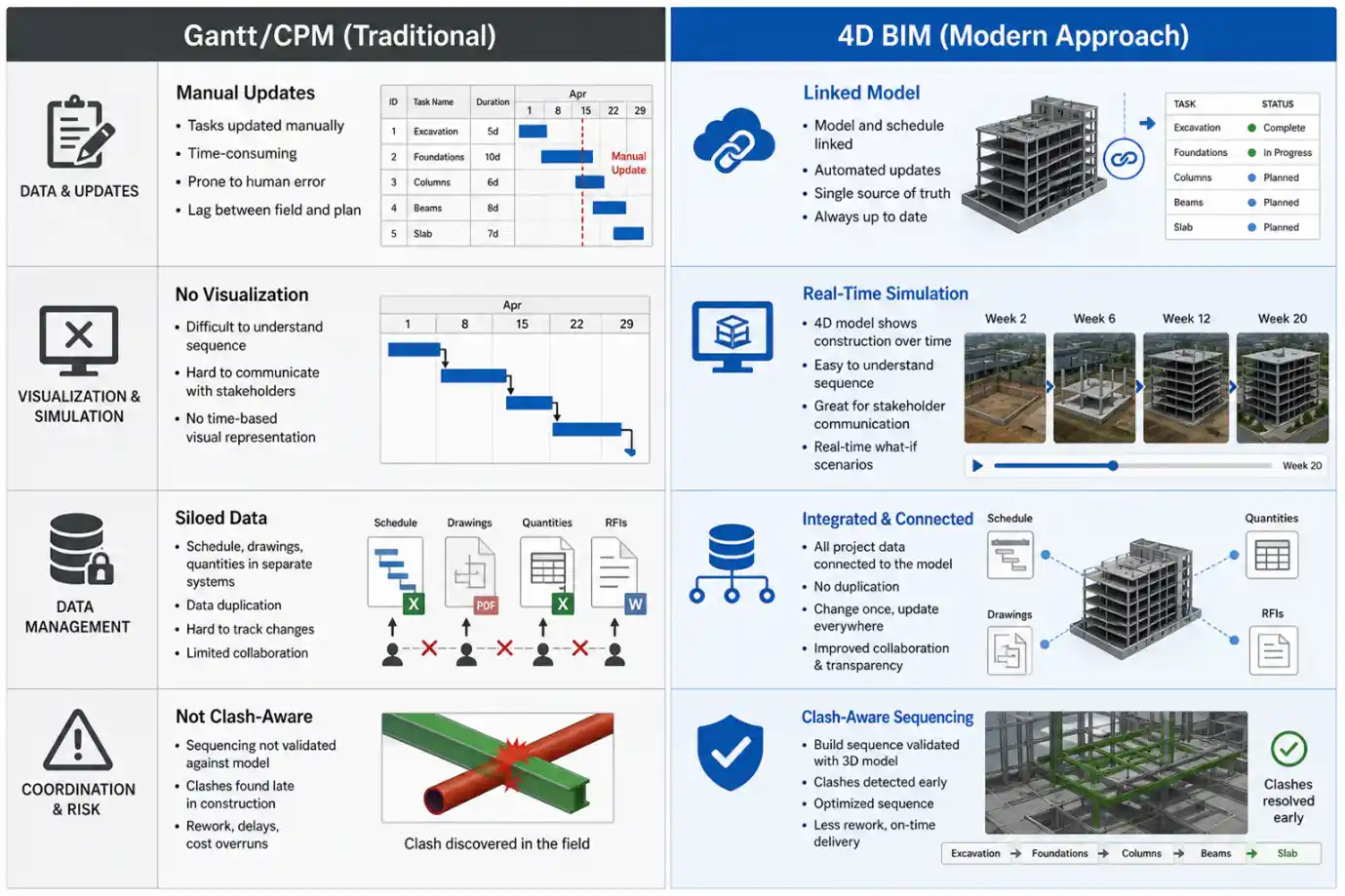
Traditional Scheduling vs BIM-Based Scheduling
Research Shows That
BIM adoption reduces project timelines by ~20%, costs by 15%, design errors by 30%, and RFIs by 25%.
These limitations have prompted the AEC industry to adopt BIM-based scheduling approaches to improve coordination, visualization, and project efficiency.
What is BIM-Based Construction Scheduling?
BIM-based construction scheduling connects project timelines to intelligent 3D models, creating a data-driven environment where construction activities can be simulated, analyzed, and optimized before work starts on site. This process is also known as 4D BIM, where the fourth dimension represents time.
Traditionally, construction scheduling often operates separately from design data. But with a BIM-based construction schedule, project stakeholders can visually understand how the building will be constructed over time rather than having to analyze complex scheduling documents separately. This improves communication, minimizes confusion, and enhances decision-making throughout the project lifecycle.
Did You Know?
The 4D BIM market reached USD 1.22 billion in 2025, representing ~26% of the total BIM market, reflecting accelerating adoption of time-linked modeling— globalgrowthinsights
How BIM Improves Construction Scheduling?
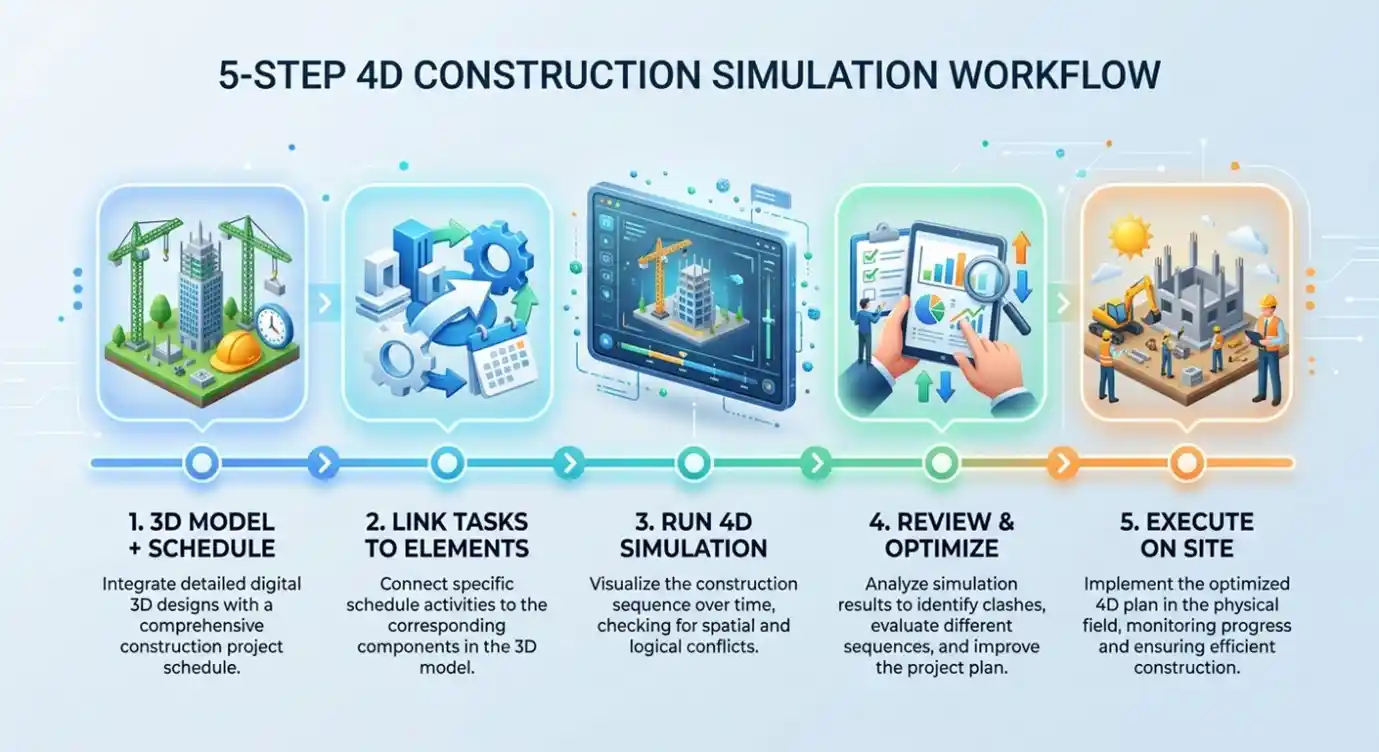
4D BIM Scheduling Workflow
1. Visual Construction Sequences Improve Planning Accuracy
BIM allows the project team to visualize the entire construction sequence before execution begins. This helps teams:
- Identify sequencing conflicts.
- Improve workflow planning.
- Understand activity dependencies.
BIM-based visualization improves planning accuracy and supports smoother project execution.
2. Early Clash Detection Prevents Schedule Delays
BIM helps resolve conflicts between structural, architectural, and MEP systems during the planning stage. This helps teams:
- Reduce construction rework.
- Prevent unexpected delays.
- Improve coordination efficiency.
Early clash detection helps maintain workflow continuity and project timelines.
3. Real-Time Collaboration Keeps Teams Aligned
BIM creates a centralized environment where stakeholders can access updated project information in real time. This helps teams:
- Improves stakeholder coordination.
- Reduce communication gaps.
- Maintain schedule transparency.
Real-time collaboration improves decision-making and project alignment.
4. 4D BIM Enhances Time-Based Project Simulation
BIM creates time-based project simulations by combining 3D models with project timelines. This helps teams:
- Visualize construction progress.
- Optimize sequencing strategies.
- Improve resource planning.
4D BIM improves scheduling efficiency and project predictability.
5. Accurate Quantity Takeoffs Improve Activity Planning
BIM allows automatic extraction of material quantities directly from project models. This helps teams:
- Improve activity planning.
- Support procurement scheduling.
- Reduce material storage.
Accurate quantity takeoffs improve the efficiency of scheduling and construction planning.
6. Optimized Resource Planning Enhances Workflow Efficiency
BIM helps allocate labor, materials, and equipment more effectively throughout the project lifecycle. This helps teams:
- Prevent resource conflicts.
- Improve workforce productivity.
- Reduce idle time on-site.
Better resource management supports smoother project execution.
7. Faster Design Revisions Improve Scheduling Flexibility
BIM automatically updates connected project information when design changes occur. This helps teams:
- Reduce delays from outdated drawings.
- Improve schedule flexibility.
- Maintain workflow continuity.
Faster updates improve coordination during project modifications.
8. Construction Progress Monitoring Becomes More Efficient
BIM improves project tracking by visually comparing actual site progress with planned schedules. This helps teams:
- Identify delays early.
- Improve project monitoring.
- Support proactive decision-making.
Efficient progress monitoring improves project control and scheduling accuracy.
9. Improved Risk Identification Supports Delay Prevention
BIM simulations help identify high-risk construction activities before execution begins. This helps teams:
- Improve project preparedness.
- Develop mitigation strategies.
- Reduce scheduling risks.
Proactive risk management supports more reliable project delivery.
10. Enhanced Communication Improves Site Coordination
Visual BIM models simplify communication between project stakeholders. This helps teams:
- Reduce misunderstandings.
- Improve site coordination.
- Enhance workflow communication.
Improved communication supports better construction efficiency.
11. BIM Supports Lean Construction Practices
BIM helps optimize workflows and eliminate unnecessary construction activities. This helps teams:
- Reduce project waste.
- Minimize repetitive work.
- Improve operational efficiency.
Lean BIM workflows support more efficient project delivery.
12. Integration with Scheduling Software Improves Workflow Automation
BIM integrates with scheduling software such as Primavera P6, Navisworks, and Microsoft Project. This helps teams:
- Automate scheduling workflows.
- Improve schedule tracking.
- Enhance project reporting,
Software integration improves construction planning and work efficiency.
Overall, BIM-based construction scheduling helps reduce project delays, improve coordination, enhance project visibility, increase productivity, and support more predictable project delivery.
Industries Where BIM Scheduling is Most Useful
BIM-based construction scheduling is highly beneficial for industries that involve complex workflows, multiple stakeholders, and strict timelines. It is widely used in commercial, residential, healthcare, industrial, hospitality, and educational construction projects to improve coordination, construction sequencing, and project efficiency.
BIM scheduling is also highly effective for large-scale infrastructure projects such as highways, bridges, airports, railways, and metro systems, where accurate planning and real-time coordination are essential. In renovation, retrofit, and data center projects, BIM improves clash detection, workflow management, and scheduling accuracy, supporting smoother, more efficient project delivery.
Future of BIM in Construction Scheduling
Advanced digital technologies that enhance project planning, coordination, and decision-making are shaping the future of BIM-based construction scheduling. As construction projects become more complex and data-driven, BIM is evolving from a visualization tool into an intelligent project management system.
AI-Driven Schedule Optimization
AI-powered BIM tools can analyze large volumes of project data to optimize construction schedules, identify workflow inefficiencies, and predict potential delays before they occur.
Digital Twins for Real-Time Project Monitoring
Digital twins create virtual replicas of construction projects that help teams monitor real-time project performance, track construction progress, and improve scheduling accuracy throughout the project lifecycle.
Cloud-Based Collaboration Platforms
Cloud-Based BIM platforms enable project stakeholders to access updated project information from anywhere, improving real-time collaboration, schedule coordination, and communication efficiency.
Integration with IoT and Real-Time Site Monitoring
The integration of BIM with IoT devices and smart construction technologies helps teams monitor equipment, workforce activity, and site conditions in real time, improving construction tracking and operational efficiency.
Predictive Analytics for Project Planning
Predictive analytics helps construction teams forecast scheduling risks, resource constraints, and potential workflow disruptions using project data insights, supporting more proactive and data-driven project planning.
Construction Scheduling Services by Tesla BIM Services
Tesla BIM Services provides BIM solutions that help AEC professionals streamline construction planning and scheduling workflows across various project types.
The company supports clients with:
- 4D BIM modeling and scheduling.
- BIM coordination and clash detection.
- Construction sequencing visualization.
- Quantity takeoffs and estimation support.
- BIM-based project planning.
- Multi-disciplinary BIM coordination.
By integrating intelligent BIM workflows into project execution, Tesla BIM Services helps construction teams improve scheduling accuracy, reduce delays, and enhance overall project efficiency.
Conclusion
Construction scheduling has evolved beyond simply managing project timelines. Modern construction projects require accurate coordination, real-time collaboration, proactive risk management, and data-driven planning to ensure efficient project execution. Traditional construction scheduling methods often struggle to meet these growing demands, especially in large and complex construction environments.
BIM addresses these challenges by transforming construction scheduling into a more intelligent, visual, and connected process. From clash detection and sequencing to project monitoring and workflow optimization, BIM improves every stage of construction planning and execution,
As the AEC industry continues to adopt advanced digital technologies, BIM-based construction scheduling will play an increasingly important role in improving project efficiency, reducing delays, and supporting smarter project delivery.
FAQ’s
How does BIM help reduce construction delays?
BIM identifies design conflicts, improves coordination among stakeholders, and enables proactive schedule management, helping reduce delays and rework.
Can BIM be integrated with construction scheduling software?
Yes, BIM can be integrated with scheduling tools such as Primavera P6 and Microsoft Project to streamline planning, tracking, and project execution.
How does BIM improve resource management during construction?
BIM provides better visibility into labor, material, and equipment requirements, enabling efficient resource allocation and minimizing site downtime.