Design-build has become a popular project delivery method across Europe. By combining design and construction under one single contract, it streamlines communication and reduces administrative overheads, giving the project owner a single point of contact. Architects, structural engineers and MEP teams all work together on the same building, but their drawings may not agree with each other. This is a result of multiple teams working in parallel, without a shared model for coordination.
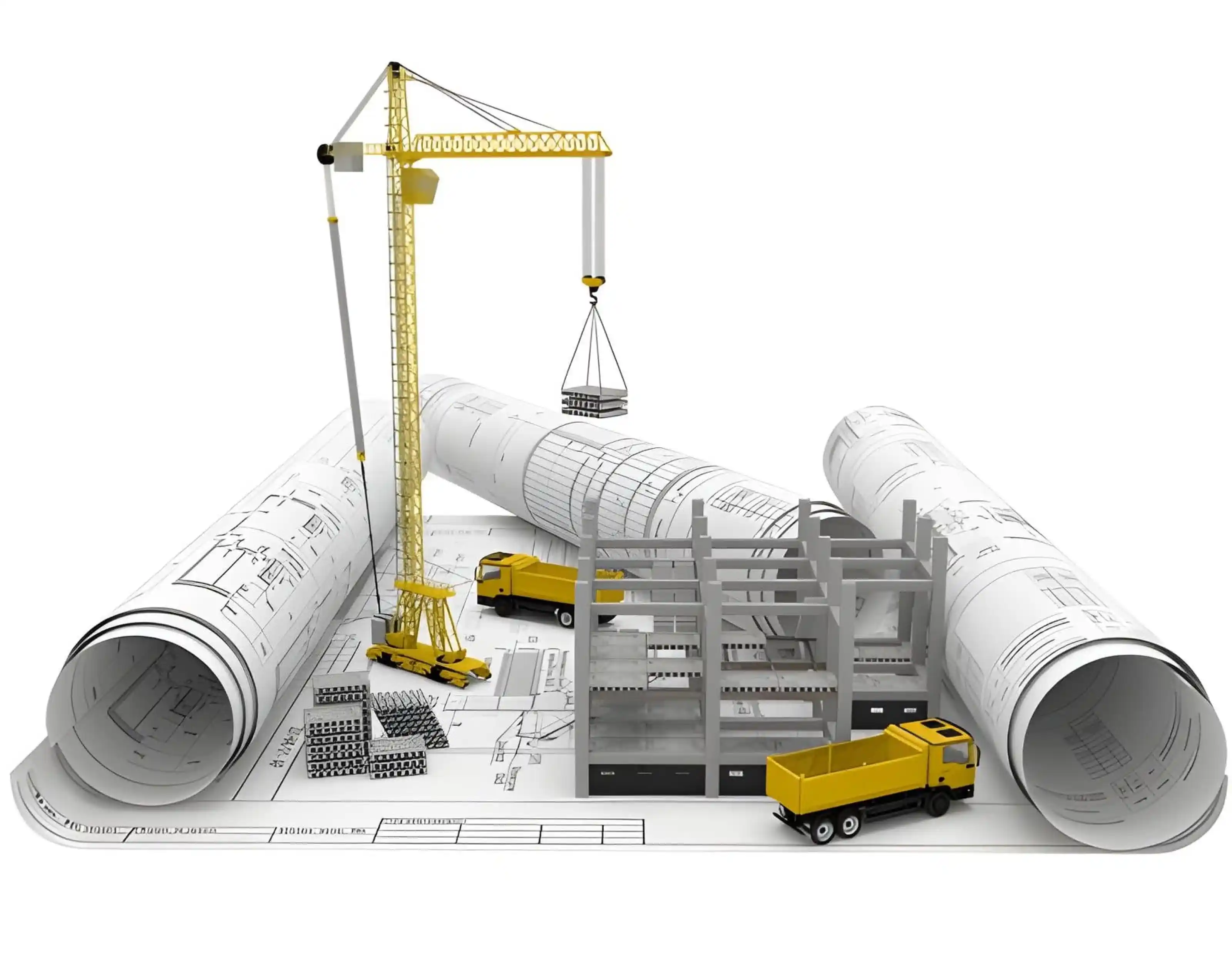
MEP BIM coordination brings every building system together in a single model, helping design and construction teams stay aligned from concept to completion.
This is where MEP BIM coordination comes into play. It is one of the most valuable steps in a design-build workflow. At Tesla BIM Services, we have worked with architects and contractors to catch conflicts & issues in parallel drawings long before they become expensive problems on site. When coordination happens early, we have firsthand experience of how smoothly the project runs.
The Real Cost of Poor Coordination
A clash that is not caught in time can bring work to a halt on site. Every contractor will have a story to tell about this situation. In a traditional design-bid-build approach, construction happens after the design is completed. This means issues occur that need to be reworked on site, leading to torn-out materials, delayed schedules and expensive change orders.
If MEP systems are modeled together in a single coordinated environment, the conflicts between them will show up on screen, not on the site. Fixing these digital clashes will cost only a fraction of the time and money compared to on-site resolution. With Design-Build, design & construction teams work in parallel, with overlapping timelines.
Where BIM Coordination Fits into Design-Build
Design-build projects have compressed timelines, with design and construction phases running closer to each other than traditional delivery methods. Speed is a big advantage, but this means there is very little room for error. Decisions are quick, and there is no time to catch problems on site, like in the traditional way.
MEP BIM coordination solves this issue. By combining architectural, structural and MEP models into one federated model, stakeholders can collaborate in real-time from a single source of data, with fewer misunderstandings. The constant availability of clash detection also helps save rework costs, very important in time-bound and tightly-budgeted projects. Coordination moves from being a reactive activity to a proactive part of the design process.
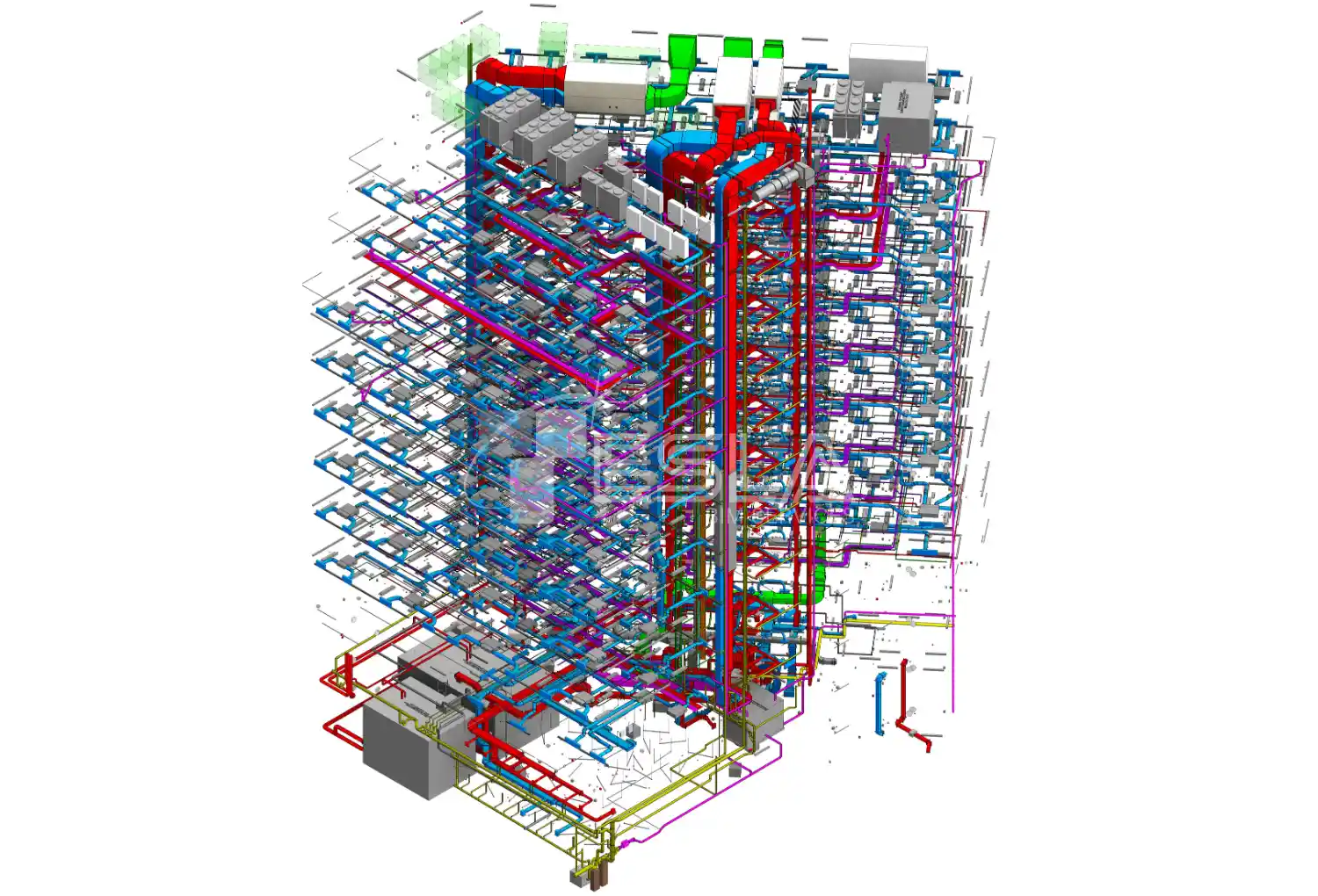
A coordinated MEP model provides a detailed view of building services, making it easier to identify clashes and optimize system layouts before construction begins.
Benefits for Architects and Contractors
Fewer surprises on site
Clashes are resolved in the model itself, which means contractors can now spend less time troubleshooting issues and more time constructing. The drawings provided to the on-site team are already checked by all the teams working on the building, and can be built & installed with confidence on-site.
A UK infrastructure case study found that BIM-enabled clash detection saves about 20% of the contract value by identifying and resolving design clashes before construction — SOURCE
Better collaboration between disciplines
A coordinated model is a single source of truth for all teams on board the project. With MEP BIM coordination, there is no guesswork. Everyone can see exactly how their work aligns with everyone else’s without having to work from siloed drawings.
More predictable budgets and timelines
A well-coordinated LOD 350 model provides reliable material quantities. This model is also checked for clashes, which means there is a very low possibility of on-site rework. This makes the budget of the project more predictable, in terms of material costs, construction labor costs, as well as a tentative idea about timelines for the project phases.
Off-Site Fabrication and Lean Construction
If MEP BIM coordination is done at LOD 400, you can extract spool drawings from the model for off-site fabrication of pipework and ductwork assemblies. This helps reduce waste during construction, improves building performance, and reduces labor & costs.
A UK BIM survey found that 72% of BIM users reported that BIM reduced the risk of problems during fabrication and construction. — SOURCE
Smoother handovers
A coordinated MEP BIM model is not just helpful during construction. This model can become a valuable asset for facilities management after the building is occupied, giving the owners accurate information of the structure as-built. This helps with future maintenance and renovations.
Making Coordination Work in Practice
Good MEP BIM coordination doesn’t mean running a one-off clash detection sequence. It works best as an ongoing process, with coordination meetings that bring architects, engineers and contractors together to review the model and resolve conflicts before moving on to the next stage.
Information management for BIM projects has to be undertaken under ISO 19650 guidelines, from coordination to clash detection and shop drawings to as-built handover. At Tesla BIM Services, we achieve this through our experience and access to technological advancements. As a BIM coordination partner, our goal is to give project teams the confidence that what has been modeled can actually be built.
Bringing it all together
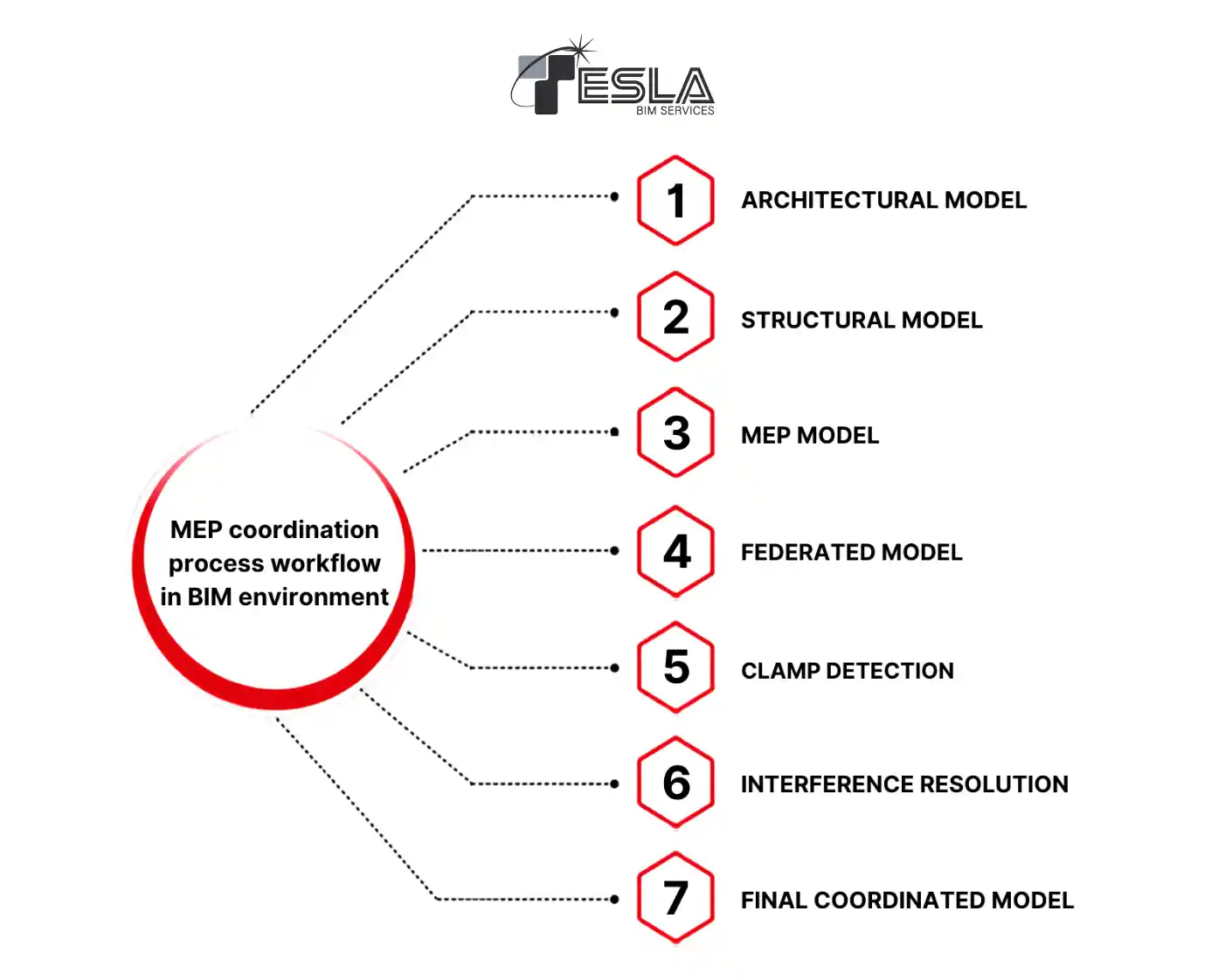
Effective coordination is built step by step – integrating design models, detecting clashes, resolving conflicts and delivering a coordinated model for construction.
According to the NBS National BIM Report (UK), 70% of BIM users reported increased productivity after implementing BIM workflows — SOURCE
Europe’s design-build AEC market is fast-paced. For projects under the ISO 19650 frameworks with tight timelines and budgets, MEP BIM coordination isn’t an additional luxury. It becomes the foundation of success and a practical choice that pays for itself several times over. If you are looking for a reliable partner to support your design-build process, Tesla BIM Services is the way to go.
FAQs
What are the most common pitfalls of MEP coordination in design-build?
There are a few root causes for MEP coordination failures:
- Starting coordination too late: if coordination starts after design is almost complete, changes become expensive on-site.
- Using BIM as a modeling task, not a process: coordination requires structured processes, regular meetings, and disciplined information management.
- Poor communication & siloed workflows: such as a lack of regular coordination meetings and no established Common Data Environment (CDE).
- MEP teams involved late: if MEP comes in after civil and interior works are done, it is risky in a design-build project.
How does a CDE support MEP coordination in design-build?
A CDE is a single platform where all project information, such as models, drawings, documents and coordination records, is stored & shared. Under ISO 19650 standards, a CDE is needed for successful MEP coordination, acting as the single source of truth for all teams.
A well-established CDE also allows structured information management, with unified folder structures, naming conventions and clear responsibility matrices.
How can a firm move from CAD MEP coordination to a full BIM workflow?
This transition isn’t automatic, and modeling MEP in Revit directly doesn’t mean the same thing as a BIM workflow. A transition from CAD to BIM means investing in BIM training, establishing clear BIM Execution Plans (BEPs) and gradually building up BIM capabilities in your team through pilot projects, which you can later scale.
Who typically leads MEP coordination in a design-build project? How does that differ from traditional delivery?
In a traditional design-bid-build project, there is no coordination because there is no one single person responsible for it. Design-build changes this fundamentally. Since design and construction are under a single contract, coordination is consolidated. There is usually a BIM Coordinator or Virtual Design & Construction Manager appointed, who is responsible for:
- Managing the federated model
- Clash detection cycle running
- Heading coordination meetings
- Ensuring that design decisions are communicated with the construction team in real-time
- Maintaining the BEP and enforcing standards
This integrated accountability means 3D MEP coordination is much more beneficial than traditional delivery methods.